
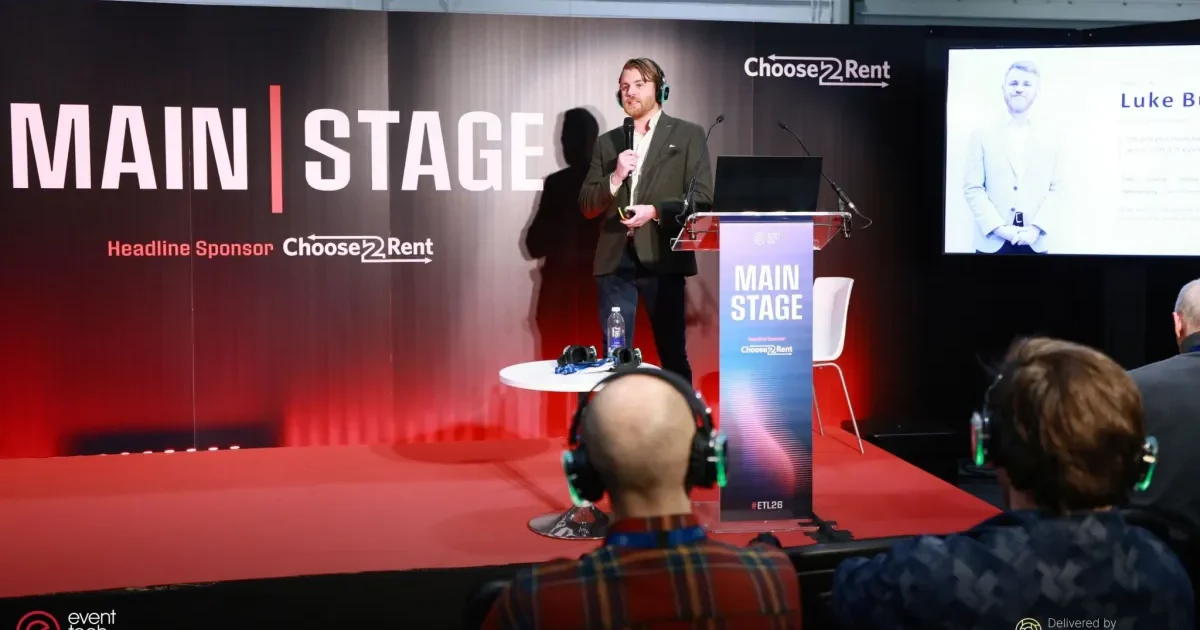
On 12 November, our Head of Sales Luke Buckley took to the Main Stage at Event Tech Live London with a session called How leading event organisers are connecting physical and digital behaviour to build more valuable, investable businesses. In 20 minutes he covered why investors now care about event data, what most post-show reports miss, and how organisers are using attendee behaviour to hold their prices, renew sponsors and plan the next edition. For most organisations, events sit inside a wider business that might include media, membership, data products or a whole marketing operation. Luke’s argument was that what attendees do at an event is one of the most valuable inputs that business has, once it’s connected to everything else it knows. Here’s what he said, and what the room asked him afterwards.
Luke joined VenuIQ as employee number one back in 2018. Since then he’s sold, scoped, delivered and marketed attendee tracking, and even built our APIs, so he knows the subject from every angle. He went straight to the money.
What investors are buying
An organiser’s value now reaches well beyond the event itself. Luke pointed to a run of major deals in the sector and focused on one. In August, Bowmark Capital took a majority stake in InfraXmedia, the business behind DCD. The announcement named market data, intelligence and data-driven sales among the reasons for the investment. Firms like Bowmark don’t usually buy events companies, Luke explained. They buy data, learning platforms and subscriptions. Event data, connected to the rest of a business’s data, opens the whole company up to a different kind of investor.
We find what we look for
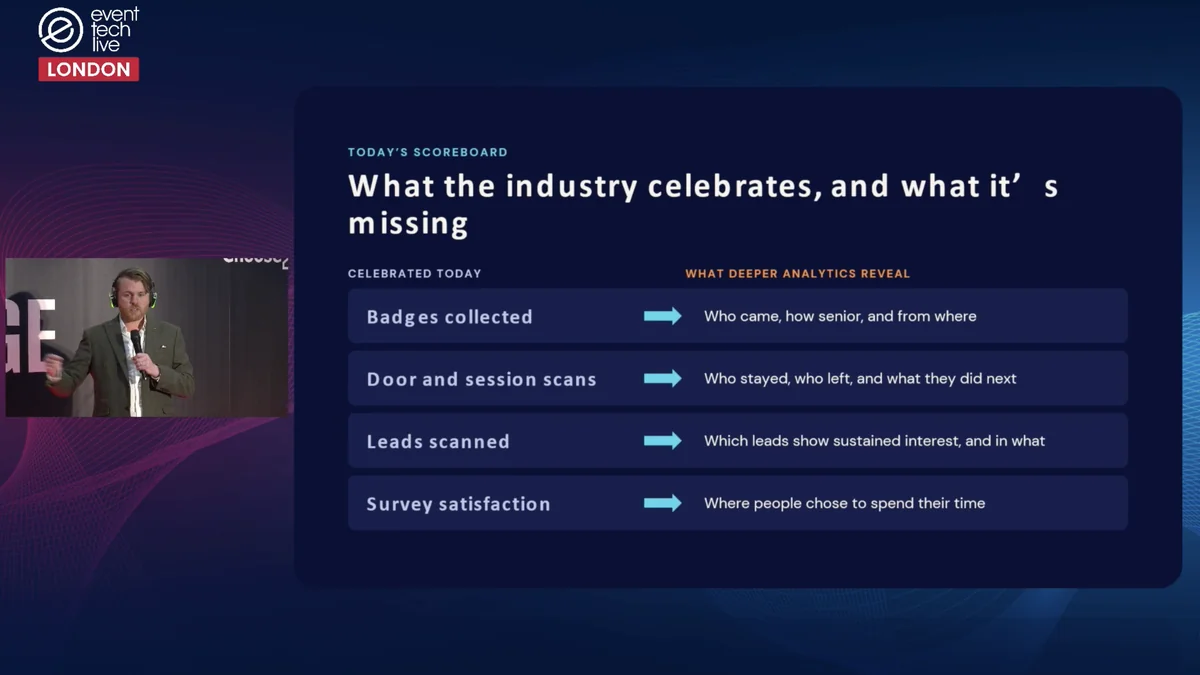
Next came a quick exercise. Luke asked the room to find everything blue around them, then close their eyes and name everything pink. Nobody could. Event reporting works the same way. If all you look for is badges collected and leads scanned, that’s all you’ll find. Luke calls these “so what” figures, and he set them against what deeper analytics shows:
| What the industry counts today | What deeper analytics shows |
|---|---|
| Badges collected | Who came, how senior they were and where from |
| Door and session scans | Who stayed, who left and what they did next |
| Leads scanned | Which leads showed sustained interest, and in what |
| Survey satisfaction | Where people actually chose to spend their time |
VenuIQ’s part of the picture is Bluetooth tracking. Every badge carries a beacon linked to the attendee’s registration profile, and small gateways around the venue ping three times a minute. Together, that data shows dwell time, journeys and the signals that point to intent, with no scanning or app needed.
The hall the exhibitors complained about
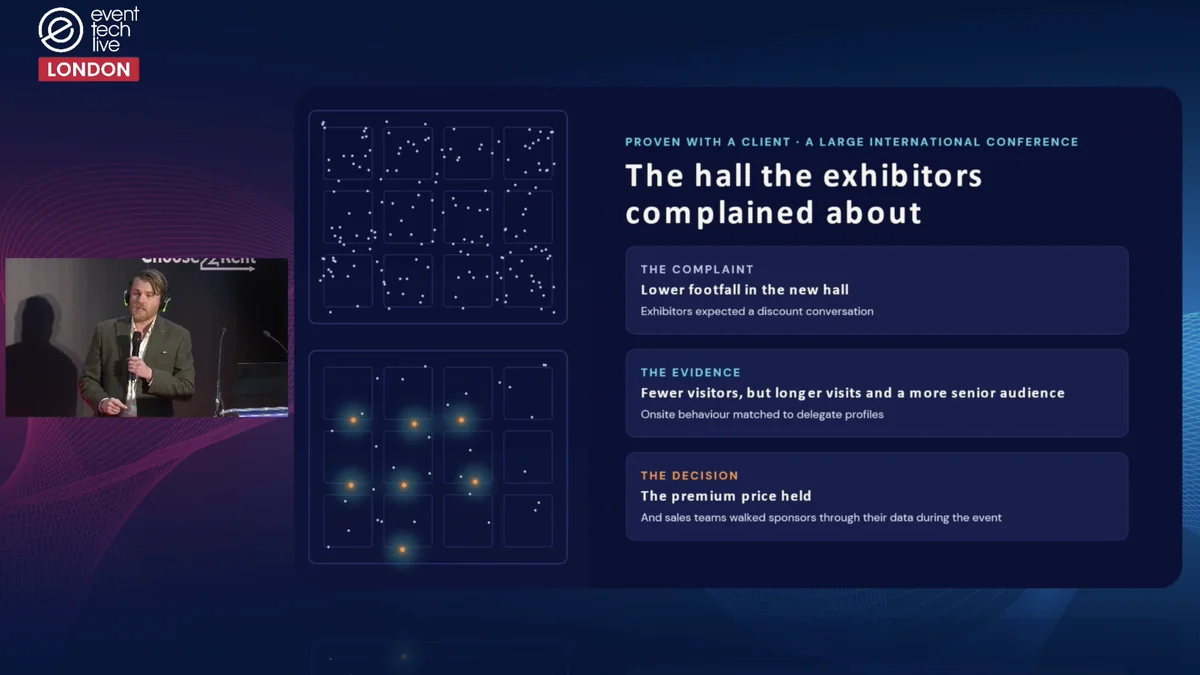
The story that got the biggest reaction came from an exhibition earlier this year with 12,000 attendees across several halls. It had grown so much that the organiser opened a new hall, about a 15-minute walk away across an internal bridge. By day two, exhibitors in the new hall were complaining about lower footfall, and talk turned to discounts on rebooking.
We crunched the data live on site. There were fewer visitors, but they stayed longer and were noticeably more senior. Measured by visitors per square metre and per booth, the new hall turned out to be the more valuable place to exhibit. The organiser held its premium price, and rebooks went through at that price.
From “how did we do?” to “what do we do next?”
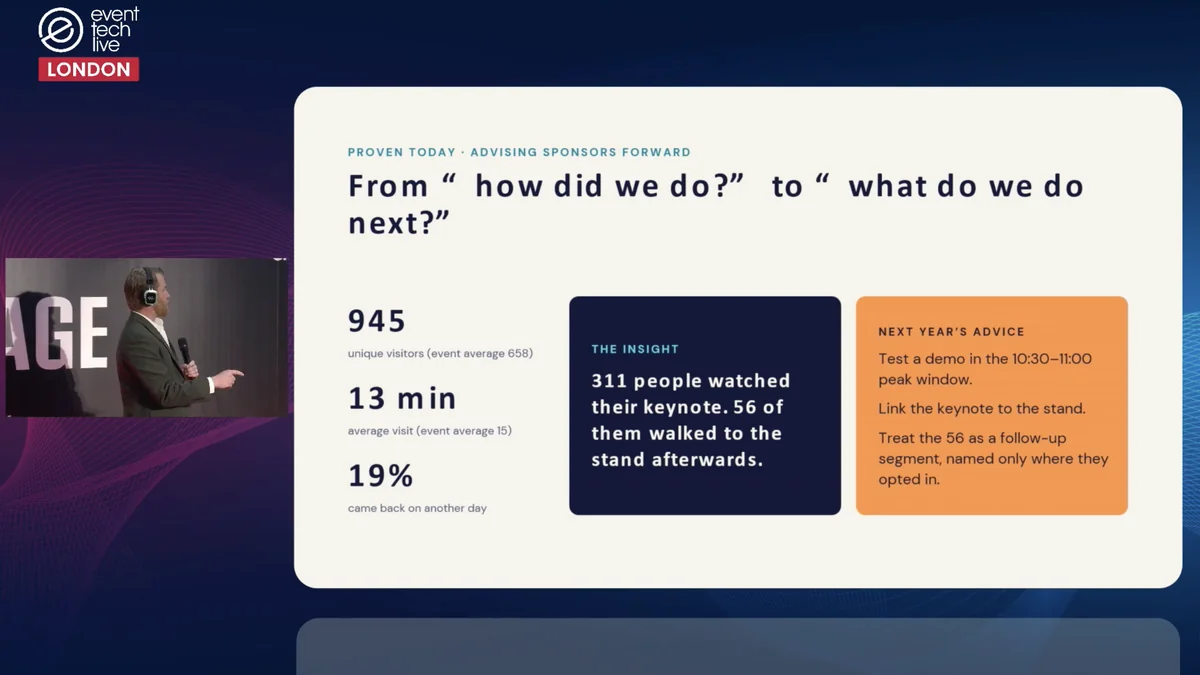
A raw number like 945 stand visitors tells a sponsor very little. Set against the event average, it starts to mean something. Luke walked through an illustrative report showing a sponsor 30% above average for visitors, with 19% coming back on another day. The bigger insight came from linking the stand to the rest of the sponsor’s package. In his example, 56 of the 311 people at the sponsor’s session walked to its stand afterwards. At some events, he said, half of a sponsor’s stand traffic comes from their session, which makes for a very easy conversation about booking one next year.
Plotting every sponsor on traffic against dwell time does the same job across the whole floor. Star performers should be rebooking and spending more. Sponsors with high dwell but low traffic are having good conversations and need more footfall, so the data points to a better position or a bigger package. Busy but shallow stands get plenty of visitors but only brief conversations, which usually means the demo, the stand or the message needs work. Sponsors with low traffic and low dwell are at risk and need a data-led conversation well before the renewal deadline. As Luke pointed out, the recommendation then comes from the data, which is a far easier conversation for a sales team to have.
From counting to year-round intelligence
Most of the industry is still at step one: counting. Step two joins onsite behaviour to registration profiles, which is where most VenuIQ clients are today. Step three, where Luke thinks everyone should be within two years, connects the physical event with digital behaviour across the year, such as webinars, downloads and white papers. Step four turns that into repeated commercial use, like subscription intelligence products that help customers prioritise leads and decide how to approach them.
He used a data centre example. Colleagues from one company attend cooling sessions and spend time at cooling stands. In the following weeks, the same account downloads a cooling report and joins a webinar. That sustained interest becomes an intent score, inferred rather than confirmed, which the organiser can share with relevant sponsors, with permission.
The same connected data serves the whole business. Sales teams use it for renewals and finding new sponsors. Marketing uses it to segment audiences and re-engage people between events. The programme team can see whether panels work, whether 30-minute sessions beat hour-long ones, and whether the plenary really needs 3,000 seats. Editorial teams use it for benchmarks and briefings, and leadership gets a live view of the business instead of a late-night WhatsApp asking for the latest figures.
Luke’s principle was to collect less and connect more. If sales, marketing, operations and digital all keep separate spreadsheets, most of the value is lost, and “that’s not an investable company.” His advice for getting started was refreshingly modest: pick one event and one commercial question, whether that’s sponsor retention, taking an event to a new location or building more year-round digital engagement.
What the room asked
The audience questions went straight to the practical issues organisers face.
How do you handle privacy and governance when sharing insight with sponsors?
The questioner’s worry was a show with more than 100 sponsors: how do you share rich insight with all of them without someone hand-building 100 reports and getting one wrong? Luke’s first rule was simple: don’t show anything personal. Job titles, companies and seniority can be shared within GDPR limits. Nobody gets access to the raw data, every report follows centrally agreed logic, and VenuIQ produces the reports, so nothing gets shared by accident. Some clients don’t even give us names, just an ID for each person alongside job title, company and other demographic fields. Linking records across events, webinars and downloads works best with a single ID, such as a CRM record, that follows each person everywhere.
Will the end of third-party cookies stop year-round linking?
Luke admitted the “cookiepocalypse” is a worry for clients’ digital channels, and organisers will need workarounds, such as identifying people when they sign in to an event platform. The physical side is unaffected, though. “We don’t have cookies in person,” he said. “I guess we are the cookies.”
How do you make sense of it all without becoming a data scientist?
Luke was honest about this one. VenuIQ used to be the company that handed clients 20 million lines of data and wished them luck, and unless a client had a strong data team, not much came of it. That changed about five years ago. We now process the data, build live dashboards and write reports in plain language that someone can pick up without a briefing. Clients with their own analysts can still have the raw data. We’ve written more on this in How to Use Event Data Without a Data Team.
Watch the full session
You can watch Luke’s talk in full on the Event Tech Live player. For the rest of our week at the show, read our Event Tech Live 2026 round-up.
Luke closed by inviting organisers to bring their latest post-show report to our stand. The offer still stands. Book a demo and we’ll show you what your event data could be telling you.